Brazil vs India: Where Should You Hire Software Developers?
Brazil and India are two major markets for international software talent. Compare developer costs, time zones, communication, talent pools and collaboration to decide which country fits your hiring strategy.
Brazil vs India: Where Should You Hire Software Developers?
When companies decide to hire software developers internationally, two very different talent markets often enter the conversation:
Brazil and India.
India has been one of the world's most established technology outsourcing destinations for decades.
Brazil, meanwhile, has become increasingly relevant for companies looking for skilled developers with stronger time-zone alignment to North America and easier real-time collaboration.
Both countries can provide significant advantages compared with hiring exclusively in high-cost local markets.
But they solve different problems.
The right question is not simply:
Which country has cheaper developers?
A better question is:
Which market provides the right combination of cost, technical talent, communication and collaboration for your company?
Let's compare Brazil and India.
Brazil vs India at a glance
The two markets have very different characteristics.
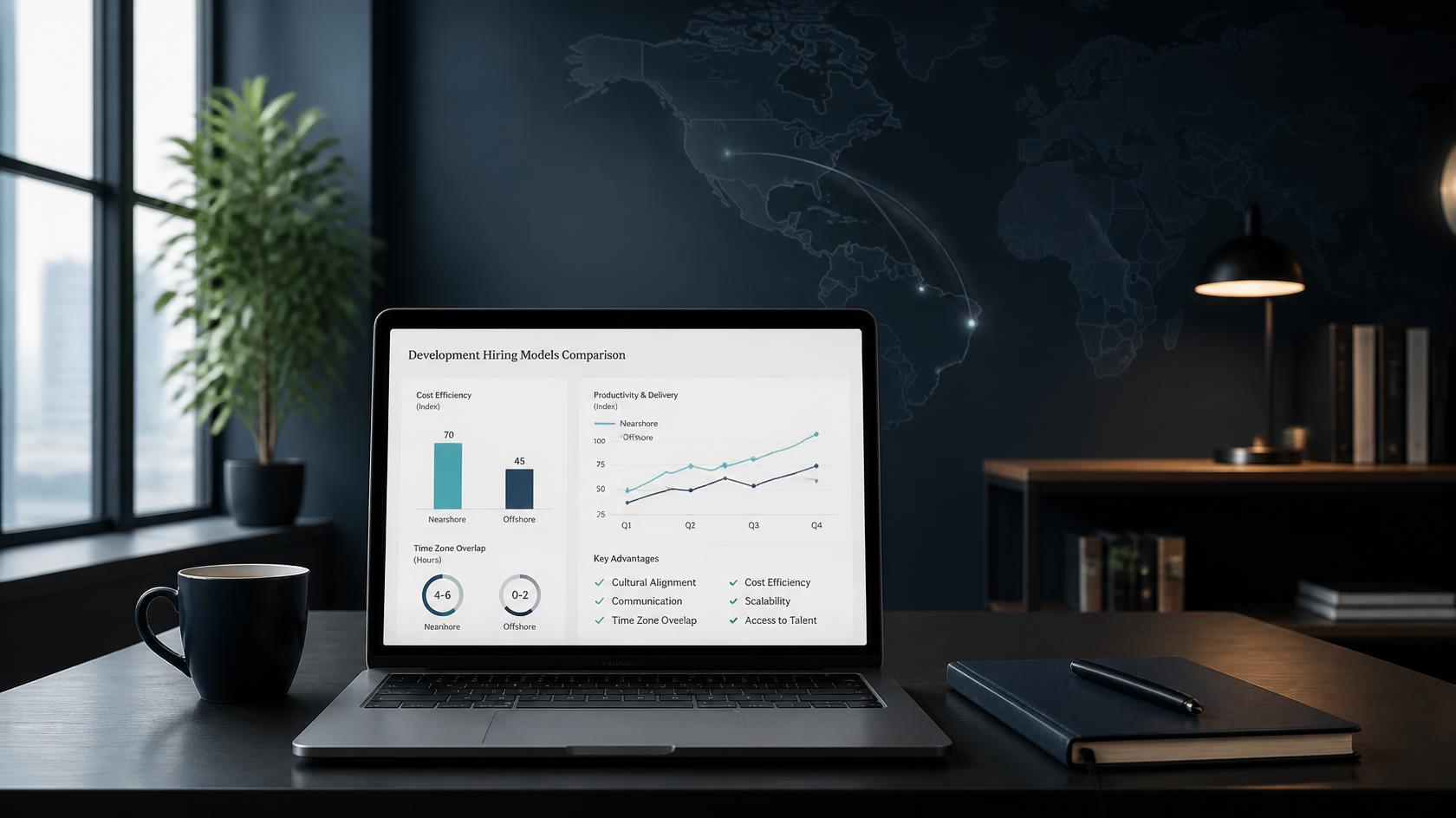
| Factor | Brazil | India |
|---|---|---|
| Talent pool | Large | Extremely large |
| Developer costs | Competitive | Often lower |
| US time-zone overlap | Strong | Limited |
| European time-zone overlap | Moderate | Stronger |
| Real-time US collaboration | Easier | More challenging |
| English availability | Varies by professional | Broadly available in tech |
| Outsourcing ecosystem | Growing | Highly mature |
| Direct international hiring | Growing rapidly | Highly established |
| Nearshore potential for US companies | Strong | Low |
| Offshore scale | Moderate | Extremely strong |
Neither market is universally better.
The best option depends on how your engineering organization operates.
Why companies hire software developers in India
India has been a major global technology hub for decades.
The country has developed an enormous ecosystem of:
- Software engineers
- IT service providers
- Outsourcing companies
- Technology consultancies
- SaaS companies
- Engineering centers
- Global capability centers
For companies that need access to a very large technology workforce, India is difficult to match.
The breadth of the market means companies can recruit professionals across technologies such as:
- Java
- .NET
- Python
- JavaScript
- React
- Node.js
- Cloud infrastructure
- DevOps
- Data engineering
- Artificial intelligence
- Cybersecurity
- Enterprise software
India is particularly strong when companies need to build or outsource engineering capacity at scale.
Why companies are hiring software developers in Brazil
Brazil represents a different international hiring proposition.
Rather than competing primarily on massive outsourcing scale, Brazil can be attractive to companies seeking professionals who can integrate closely with teams in the Americas.
The Brazilian technology ecosystem includes developers working across:
- Software engineering
- Cloud infrastructure
- DevOps
- Data
- Product development
- Mobile applications
- Cybersecurity
- ERP systems
- UX and product design
For US and Canadian companies, one of Brazil's biggest advantages is geography.
Brazilian professionals can typically maintain meaningful working-hour overlap with North American teams.
That changes how international collaboration works.
Instead of sending a request and waiting until the following day for a response, teams can often communicate during the same business day.
For product companies and startups, this can be extremely valuable.
Which country has cheaper software developers?
If the comparison focuses only on compensation, India often has an advantage.
Its enormous technology workforce and mature outsourcing ecosystem provide companies with access to developers across a very wide range of price points.
Brazil is also significantly more cost-competitive than many technology markets in the United States and Western Europe.
However, international hiring costs should not be measured only by salary.
Companies should consider the total cost of building and managing the team.
That includes:
- Developer compensation
- Recruitment
- Management
- Communication
- Rework
- Project delays
- Employee turnover
- Time-zone coordination
- Onboarding
- Contractor or employment administration
The market with the lowest salary does not automatically produce the lowest total cost.
For a broader comparison of these factors, read our guide to offshore vs nearshore development.
Time zones: one of the biggest differences
Time-zone compatibility is one of the clearest distinctions between Brazil and India.
Brazil and North America
Brazil shares substantial working-hour overlap with many locations in the United States and Canada.
Depending on the city and season, a Brazilian developer may work at nearly the same time as colleagues in major North American business centers.
This makes activities such as these easier:
- Daily stand-ups
- Sprint planning
- Pair programming
- Product discussions
- Technical reviews
- Client meetings
- Incident response
- Real-time troubleshooting
The developer can function as part of the company's daily operation rather than as a separate offshore team.
India and North America
India is considerably farther ahead of US time zones.
Companies can still collaborate successfully, and thousands already do.
But the operating model often requires more asynchronous communication.
Teams may need:
- More detailed documentation
- Carefully scheduled overlapping hours
- Strong handoff processes
- Greater planning discipline
- Managers experienced with distributed teams
For structured engineering environments, this may not be a problem.
For highly collaborative product teams, it can matter considerably.
What about companies in Europe?
The comparison changes for European companies.
India has considerably better working-hour alignment with Europe than it does with North America.
For a UK or European company, Indian developers may have meaningful overlap during the working day.
Brazil can also work with European organizations, particularly when some flexibility in schedules exists, but the geographic advantage Brazil offers North American companies becomes less pronounced.
This illustrates why international hiring decisions should not be based on country rankings alone.
The location of the hiring company matters.
Talent pool: India has the advantage in scale
When it comes to pure volume, India is one of the largest technology talent markets in the world.
Companies looking for hundreds or thousands of technology professionals can access an ecosystem specifically built to support that kind of demand.
India also has decades of experience serving international companies through:
- IT outsourcing
- Managed services
- Offshore development centers
- Business process outsourcing
- Global capability centers
Brazil has a substantial technology workforce as well, but the ecosystem operates at a different scale.
For a company hiring several specialized engineers rather than building a massive offshore delivery organization, however, the size of the overall market may be less important.
The real question becomes whether the right professionals are available for the specific roles being hired.
Communication and English proficiency
English is another important consideration.
India has a long history of English-language education and international business services.
Many technology professionals work in English throughout their careers, particularly those serving international clients.
Brazil's technology workforce is more variable.
Some developers have advanced or fluent English, particularly professionals who have already worked with US or European companies.
Others may have strong technical skills but more limited spoken English.
This means companies recruiting in Brazil should evaluate language ability carefully when the role requires frequent international communication.
The level of English required should also match the actual job.
A backend developer working primarily within an engineering team may require a different communication level than:
- Engineering managers
- Solutions architects
- Product managers
- Consultants
- Client-facing developers
Requiring near-native English for every technical role can unnecessarily reduce the available talent pool.
Cultural and working-style considerations
International hiring always involves some degree of cultural adaptation.
Neither Brazilian nor Indian developers should be treated as a single uniform group.
Individual experience matters far more than nationality.
However, companies should evaluate how candidates have previously worked.
Relevant questions include:
- Have they worked remotely?
- Have they collaborated with international teams?
- Are they comfortable communicating independently?
- How do they handle unclear requirements?
- How do they communicate delays or technical problems?
- Have they worked in agile environments?
- Are they accustomed to direct stakeholder interaction?
A developer who has already worked successfully within distributed international teams may integrate faster regardless of location.
Brazil vs India for startups
Startups have a particular set of requirements.
Their development environments tend to change quickly.
Product priorities can shift frequently.
Developers may need to work directly with:
- Founders
- Product managers
- Designers
- Customers
- Other engineers
In these situations, communication speed can become especially important.
India may be attractive when:
- Budget is highly constrained
- Work is clearly defined
- Asynchronous processes are mature
- The company already knows how to manage offshore teams
- Engineering capacity needs to scale significantly
Brazil may be attractive when:
- Developers need to participate in the core product team
- Daily US collaboration is important
- Requirements change frequently
- Founders work directly with engineers
- Real-time communication matters
- The company prefers a nearshore model
Neither approach is inherently superior.
They optimize for different priorities.
Brazil vs India for enterprise companies
Large enterprises may approach the decision differently.
India's mature technology services ecosystem can be extremely attractive for organizations seeking:
- Large offshore teams
- Managed services
- 24-hour operations
- Enterprise outsourcing
- Large-scale support
- Dedicated development centers
Brazil may be particularly relevant when enterprises need:
- Latin American technology operations
- Professionals aligned with US working hours
- Bilingual or multilingual regional teams
- Smaller specialized engineering groups
- Nearshore support
- Direct-hire professionals integrated into internal teams
Some multinational companies use both markets for different purposes.
International hiring does not need to be a Brazil-versus-India decision across the entire organization.
Direct hiring vs outsourcing
Another important distinction is how the developers will actually work for the company.
Outsourcing
A company contracts another organization to provide development capacity or deliver a project.
India has an exceptionally mature outsourcing industry.
This can make it easier for companies that want to rapidly obtain complete development teams without recruiting every individual professional themselves.
Direct international recruitment
The company selects individual developers and integrates them directly into its organization.
This provides greater control over:
- Technical standards
- Culture
- Compensation
- Performance
- Retention
- Team structure
Brazil can be particularly attractive for this model because developers can operate within similar working hours to North American teams.
Companies considering this approach can read our guide on how to hire developers in Brazil.
What does developer seniority change?
International salary comparisons often become misleading because they compare professionals with different levels of experience.
A junior developer in one country should not be compared with a senior developer in another.
Companies should evaluate:
- Years of relevant experience
- Complexity of previous projects
- Technical specialization
- Product experience
- International experience
- English proficiency
- Leadership responsibilities
- Ability to operate independently
Senior developers with strong international experience command higher compensation in both Brazil and India.
They may still provide significant cost advantages relative to equivalent professionals in higher-cost markets.
For more context about the Brazilian market, see Brazilian Developers: Skills, Salaries and What Global Companies Should Know.
When India may be the better option
India deserves serious consideration when your company needs:
- The largest possible developer pool
- Large engineering teams
- Highly mature offshore outsourcing infrastructure
- Aggressive direct labor cost optimization
- 24-hour development cycles
- An established offshore delivery model
Companies experienced in managing asynchronous international teams can extract significant value from the Indian technology market.
When Brazil may be the better option
Brazil can be especially attractive when your company needs:
- Strong overlap with US business hours
- Real-time collaboration
- Direct integration with internal product teams
- Nearshore rather than offshore development
- Easier communication with North American stakeholders
- Skilled professionals at competitive international compensation
For organizations where collaboration is as important as cost, these advantages can have a significant operational impact.
Should US companies choose Brazil or India?
For US companies, the decision often comes down to what type of international team they are building.
If the priority is:
Maximum scale and lower direct labor costs, India may be more attractive.
If the priority is:
Cost efficiency combined with real-time collaboration, Brazil may be the stronger fit.
This is especially relevant for companies building internal product teams rather than outsourcing complete projects.
A Brazilian engineer can often participate in the same meetings, respond to the same product issues and collaborate with the same stakeholders during normal US business hours.
That can make the working relationship feel much closer to domestic remote hiring.
Don't choose a country before defining the role
One of the most common mistakes in international recruitment is selecting a country before clearly defining the talent requirement.
Instead, companies should first establish:
- Which technical skills are required?
- What seniority level is needed?
- How much real-time collaboration is necessary?
- What level of English is required?
- What working hours must overlap?
- What is the realistic compensation budget?
- Will developers be direct team members or outsourced resources?
- How quickly must the company hire?
Once those questions are answered, the right market becomes much easier to identify.
Brazil vs India: which should you choose?
There is no universal answer.
India offers an extraordinary technology ecosystem, an enormous talent pool and one of the world's most mature offshore development industries.
Brazil offers competitive software talent combined with a geographic advantage that can make collaboration significantly easier for companies in North America.
The decision depends on what your organization is optimizing for.
Choose India when scale, outsourcing maturity and direct labor cost are the dominant considerations.
Consider Brazil when cost efficiency needs to coexist with time-zone alignment, frequent communication and close integration with your existing team.
Ultimately, companies should not search for the cheapest country.
They should search for the market that allows them to build the most effective team for the total cost.
Hiring software developers in Brazil
Companies entering a new international talent market often face challenges involving compensation, sourcing, candidate evaluation and local expectations.
A local recruitment partner can help companies understand the market before committing to a hiring strategy.
At Vettarya, we help international companies identify, evaluate and hire professionals in Brazil through targeted sourcing and structured recruitment.
Our goal is not simply to provide more candidates.
It is to help companies understand which professionals are most likely to succeed within their organization.
Learn more about recruiting professionals in Brazil.
Validate. Evaluate. Connect. Grow.